
Industry
Hospitality — a mountain hotel and resort in Azad Kashmir.
Case Study — Hospitality Website
We designed and developed the website for The Royal Peaks, a mountain hotel and resort beside the Kundal Shahi Waterfall in Neelum Valley, Kashmir — built so a guest can see every room, every rate, and every verified review in one scroll, then book direct with the hotel rather than through a travel platform.
Request a Similar Hotel Website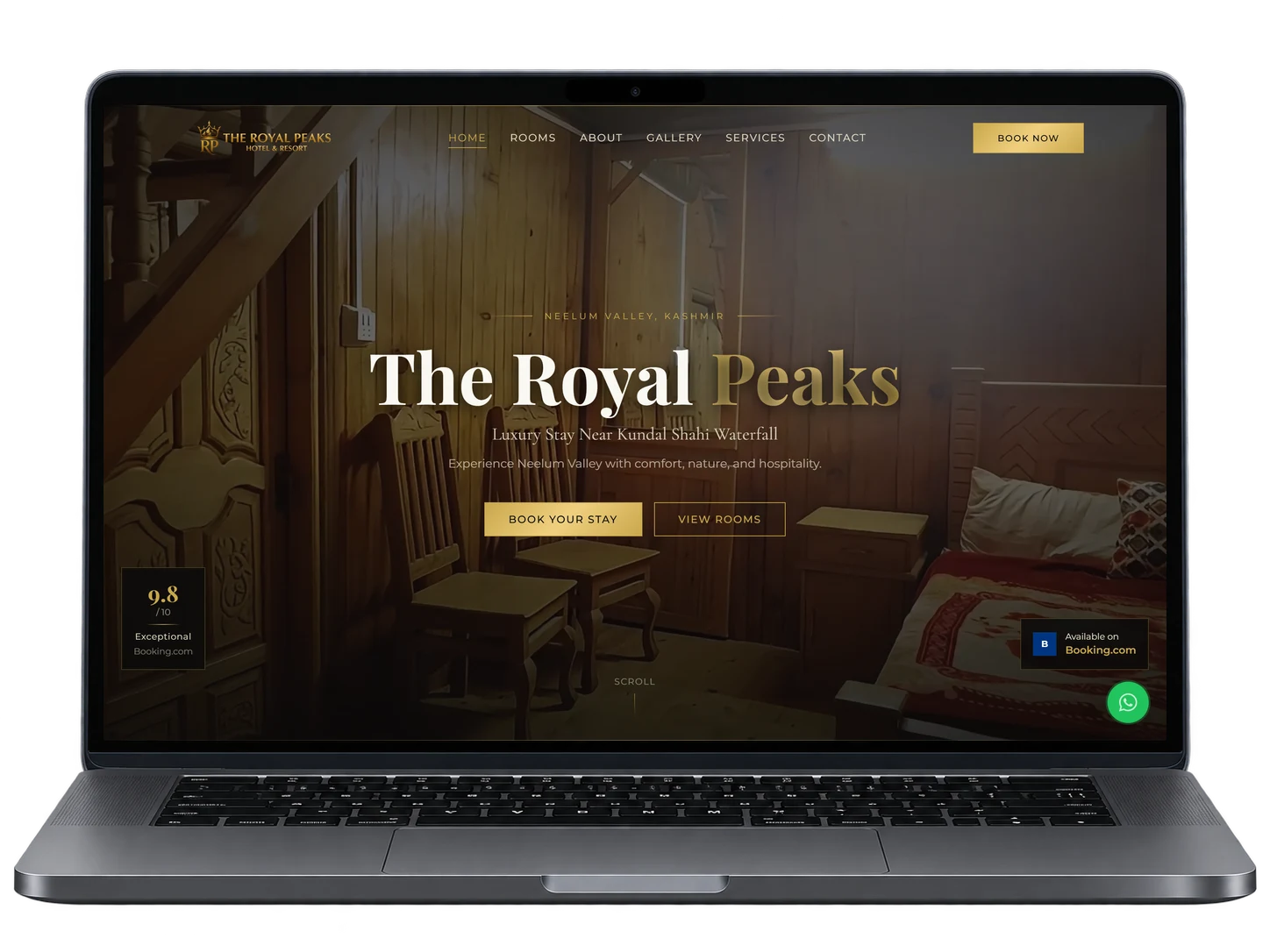
theroyalpeaks.com
The Royal Peaks sits in Babu Muhalla Kutton, a few hundred metres from the Kundal Shahi Waterfall and the Neelum River. It is a genuinely well-reviewed property — 9.8 out of 10 on Booking.com — but the bookings were arriving through travel platforms that take a share of every stay and keep the guest relationship. The website had to become the place travellers find the hotel, understand it, and reserve from directly.
Hospitality — a mountain hotel and resort in Azad Kashmir.
Design and build of the complete hotel website.
Turning interest into a direct reservation.
Someone planning a trip to Neelum Valley is committing money to a hotel in a remote valley, usually from a phone, often on a weak connection. Everything that would normally reassure them — the building, the room, the food, the staff — has to be carried by the website.
Reservations arriving through a travel platform cost the hotel a share of each stay, and the guest relationship belongs to the platform rather than the property.
An independent hotel has none of the recognition a chain carries, so the proof has to be shown rather than assumed.
Travel research happens on phones, and a photo-heavy hotel site is exactly the kind of page that stalls on a slow connection.
Couples, small families and larger groups all need a different room, and a single generic rate leaves each of them guessing.
Rather than scatter the hotel across a dozen pages a guest would have to hunt through, we built a single guided flow — welcome, gallery, reasons to stay, rooms and rates, facilities, reviews, location and FAQs — with a booking action always one tap away. The navigation still carries the familiar labels, but each one moves the guest down the page instead of starting again.
Implementation summary
Every room type carries its nightly rate, how many guests it sleeps, the bed layout and the view — so a guest self-selects before they ever make contact.
Real guest comments from Booking.com and Google are shown with the reviewer, the score and the source — including the staff guests name personally.
The booking path is deliberately short — reserve direct for the best rate, or send a WhatsApp message, which is how most travellers in this market prefer to ask.
A full-screen slideshow and gallery of the actual rooms, balconies, dining and grounds — not stock photography a guest would feel misled by on arrival.
The valley is the reason people come, so the site states exactly how far the waterfall, the river, the trails and the village are from the door.
Check-in times, pets, breakfast, transfers, payment methods and cancellation are answered on the page, removing the questions that otherwise delay a booking.
The page is ordered the way a traveller actually decides: where is it, what does it look like, why here, what does it cost, what do other guests say, how do I book.
The rating badge sits in the hero and the review wall comes before the final booking push, so the request to reserve lands after the reassurance rather than before it.
A fixed header button, in-section buttons on every room, and a floating WhatsApp control mean the guest never has to scroll back to act.
A warm gold-and-charcoal palette carries the premium positioning through the hero, the room cards, the buttons and the footer without competing with the photography.
Type sizes, tap targets, stacked room cards and a collapsing FAQ all hold up on a small screen, which is where most of this audience is browsing from.
Hotel websites live and die on imagery, and imagery is what makes them slow. The build balances the two, and is structured so a search engine can tell exactly what the property is and where it sits.
Gallery and room imagery is compressed and loaded progressively, so the first screen appears quickly instead of waiting on the whole set.
Headings, copy and metadata name the valley, the waterfall and the village — the terms travellers actually search when planning a Neelum Valley trip.
Layouts, navigation and booking actions were designed for the phone first, then expanded outwards to tablet and desktop.
The Royal Peaks has a website that presents the property as well as a travel platform does, carries the same verified proof, and sends the guest to the hotel instead of through an intermediary — with every room, rate, facility and policy stated before the enquiry is made.
If most of your bookings arrive through a platform that takes a cut, we can build you the direct channel — rooms, rates, reviews and enquiries, on a site your guests trust.
Request a Similar Hotel WebsiteQuick execution with clean approvals at every stage.
Every solution optimised for growth, not just launch day.
Cutting-edge solutions built around modern needs.